A Bellevue house that has sunk, tilted or dropped at a corner has a ground or footing problem, and Bellevue Foundation Repair starts by working out which. Floors that run downhill, doors that stick or leave a wedge-shaped gap and cracks that open wider at one end are the signs.
Our work covers Bellevue and reaches Mercer Island and Newcastle. In Bellevue, 46.7 percent of homes were built before 1980 and the median home dates from 1982. Slopes and wet ground in parts of the city mean the cause of a move can be the hillside, and the critical areas code may then apply.
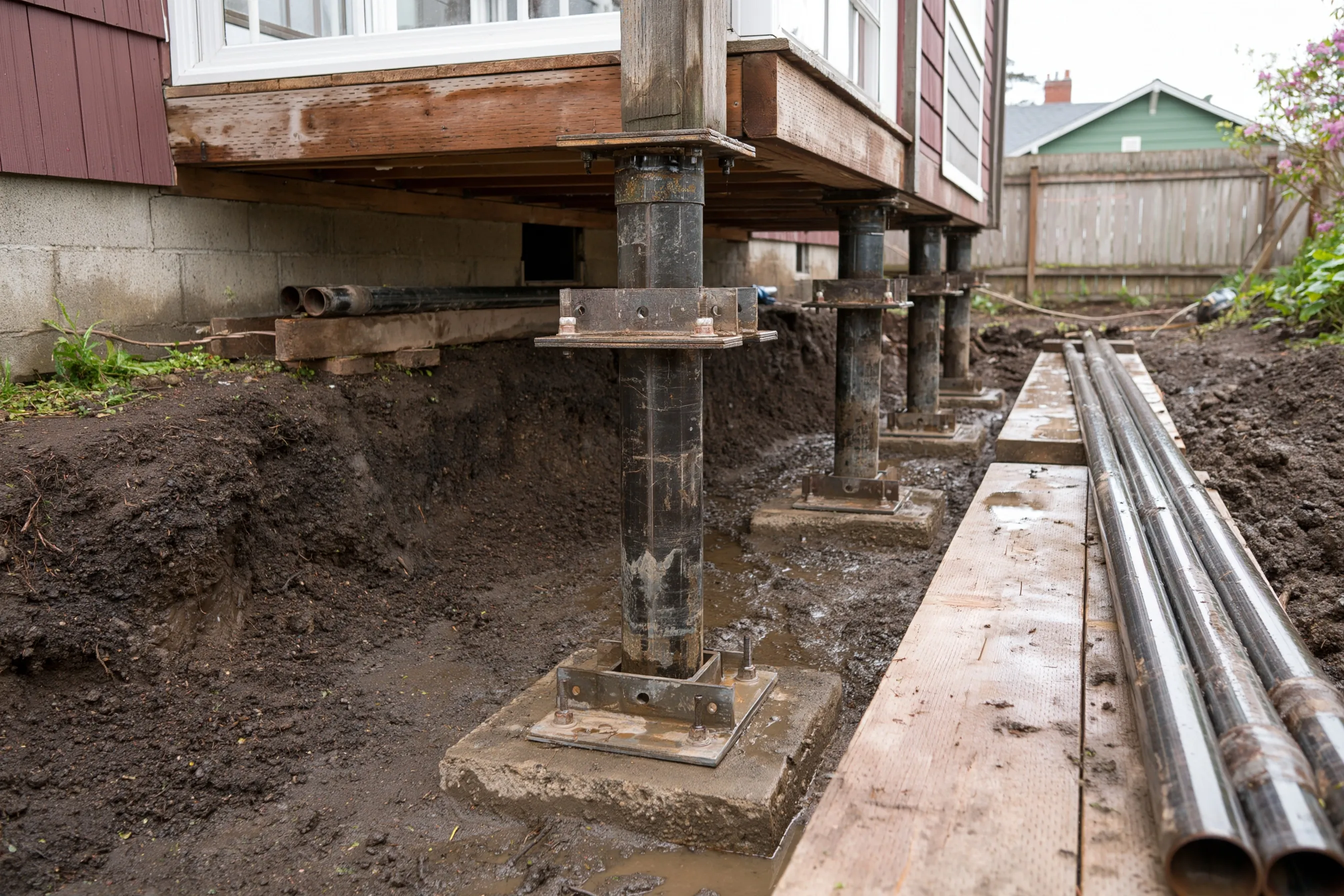
‘Push pier’ is trade talk. HUD’s word is mini-pier, and its description is specific: steel, 2 to 8 inches in diameter, driven hydraulically beside the footing until it reaches rock or an adequate bearing layer, with the weight of the building as the reaction. The cautions come in the same passage. Incorrect use can crack the foundation and slab, and the economics need that bearing layer to be fairly shallow.
Helical piers
Rotation, not driving, puts a helical pier in the ground. A steel shaft with a helical plate is screwed into stable soil and then bracketed to the footing; the torque logged during installation points to how much load the soil can bear. HUD states the limit directly: where the soil has little bearing capacity, the method fails.
Underpinning
Underpinning enlarges the footing under a settled wall. HUD calls it dangerous, expert-only work that should be designed by an engineer for the soil on site, so it is the option with the most conditions, and HUD adds that silty or expansive soils may defeat it.
Stopping movement and getting back to level
Stopping a house from moving is one aim; bringing it back to level is another. HUD describes one pier method as difficult for raising a foundation more than a few inches. We do not promise a floor will come back level, and we say in the written scope what the work is meant to do.
Signs a house is settling
Watch for sloping floors, doors and windows out of square, gaps where a wall meets the floor or ceiling, and tapering cracks. HUD’s inspection guide ties tapering cracks to differential settlement under projecting parts of a building, such as a bay window or porch, where foundations or piers fall short.
HUD also observes that settlement happens over time rather than as a dramatic event, leaving time to prepare a proper fix. That does not cover a leaning wall or movement on a slope; those need a quick look.
HUD lists five root causes of foundation failure. One is the site; another is poor soil (peat and other organic soil, silt, fill that was never compacted in layers); then seismic activity; water moving through soil or flooding; and design or materials that fall short.
Peat is one soil that settles. Washington’s Department of Natural Resources says it occurs in 28 of 39 counties, mostly around the sound, and settles heavily under load and drying. Whether a given lot has any is found by looking at the site. Water belongs on the list too, and the foundation drainage page explains how: HUD says it can wash fines from under a footing and press on walls until they crack and move.
Cause is for an engineer to establish, in HUD’s view, ideally a structural or geotechnical one used to this kind of work. Engineering is not part of what we offer. Where a job calls for an engineer’s evaluation or stamped design, the engineer is one you hire.
Whether a pier job needs a permit is a question for the city, covered under the Bellevue heading below. Washington’s registration rules for engineers and contractors are separate from permit rules.
Piering is priced from the number of piers, the depth to firm soil and the access, so no one can price it from a photo. The factors:
The cause of the movement and the method it points to
How many piers or footing sections the load needs and how deep they must go
Access along the foundation: slope, decks, fences and plantings
An engineer’s report, a permit or a critical area review
Finishes to remove and replace, inside and out
What Bellevue lots and rules add
If the lot is inside a landslide or steep-slope area, the cause of a settled house may be the slope and not only the footing, and the buffer and study rules in the city’s critical areas code apply before work. The definitions of those areas are set out on the home page, and the city checks a particular parcel.
Bellevue also designates seismic hazard areas, which include areas the state maps as having moderate-to-high or high liquefaction susceptibility. Washington’s rule on geologically hazardous areas says settlement and liquefaction occur in low-density soils with a shallow water table, so a wet lot on soft ground deserves a geotechnical opinion, not only a pier count.
We do not promise it. Piers aim to stop a foundation moving. HUD describes one pier method as difficult for raising a foundation more than a few inches, so a recovery of level is a separate question that depends on the house.
Push piers or helical piers?
Which one fits depends on the ground under your house. Push piers need firm bearing within reach, helical piers cannot make up for poor bearing, and a geotechnical opinion is how you find out which describes your lot.
How do I know if my house is still settling?
Mark the ends of cracks with a dated pencil line, photograph door gaps with a tape or level in view and check again after a few weeks. A mark that has been passed means movement; one that has not is worth telling us when we visit.
Which rooms or walls show the problem, and when was the house built? Say whether it has a crawlspace or a basement, whether the lot slopes and whether you have noticed any crack changing. We'll get back to you soon with an estimate or any questions we have. Estimates are free and there's no obligation.